

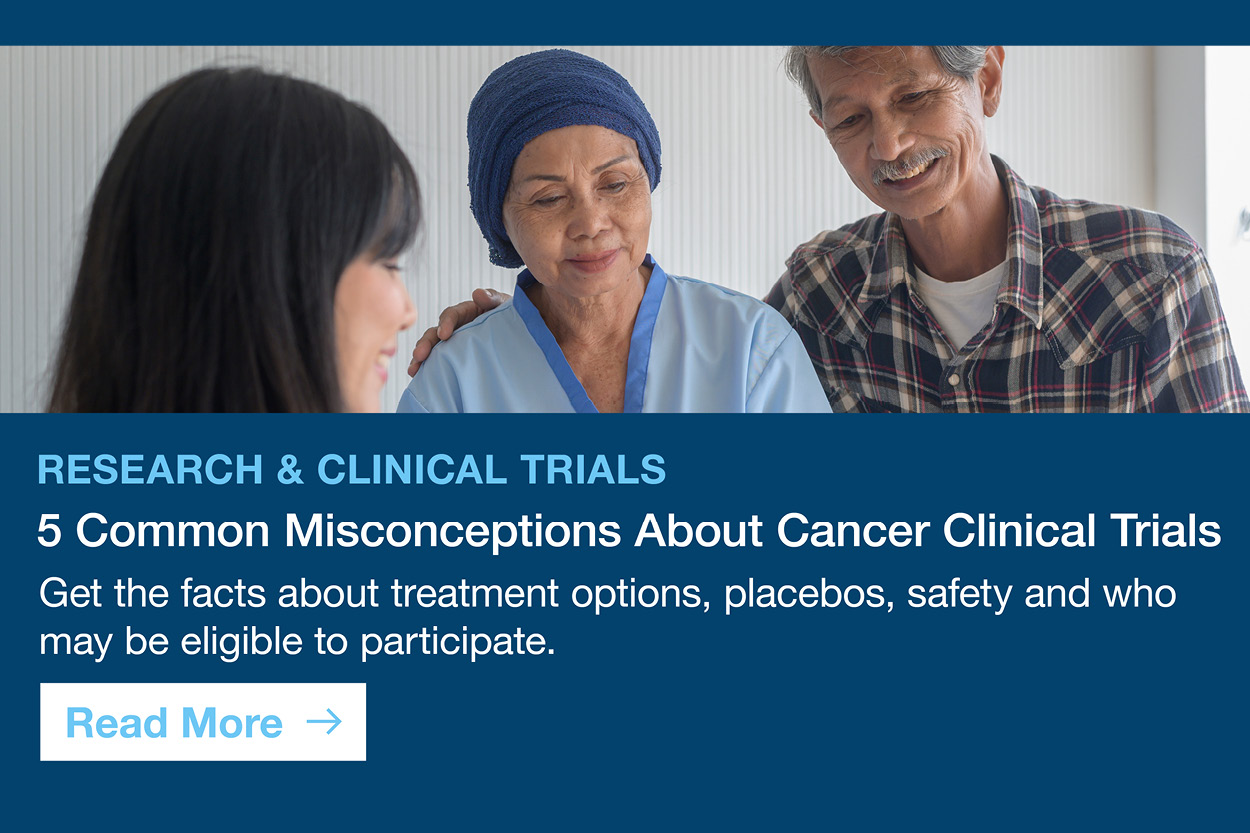
Five Common Misconceptions About Cancer Clinical Trials
Cancer clinical trials play an important role in advancing cancer care and may also be a treatment option for eligible patients. However, misconceptions about how they work can make patients hesitant to consider participating. Clinical trials help researchers evaluate new treatments, new combinations of existing treatments and other approaches that may eventually become part of standard cancer care.
For patients, however, the words "clinical trial" can sometimes bring uncertainty. Will I receive a placebo? Does participating mean there are no other treatment options? Will I be treated like a test subject?
Understanding what clinical trials actually involve can help patients and their families have more informed conversations with their care teams.
Misconception #1: Clinical Trials Are Only a Last Resort
Do you have to run out of treatment options before considering a clinical trial? No. Clinical trials are available for people at different stages of cancer, including some patients who have been newly diagnosed. There are also studies focused on cancer prevention, screening, supportive care and survivorship.
Whether a particular trial is appropriate depends on its eligibility requirements. These can include the type and stage of cancer, previous treatments, overall health, age and specific characteristics of the tumor.
For some patients, discussing clinical trials earlier in the treatment-planning process may provide additional options to consider alongside standard treatments.
Misconception #2: Everyone in a Clinical Trial Receives an Experimental Treatment
Clinical trials are carefully designed research studies, and the treatment a participant receives depends on the specific trial.
Some cancer treatment trials compare a new approach with the current standard treatment. Others may study a new treatment in combination with an established therapy or evaluate a different way of using an existing treatment.
Before joining a study, patients go through an informed consent process that explains the purpose of the trial, the treatments or procedures involved, potential risks and benefits and what participation will require.
Misconception #3: You Might Get a Placebo Instead of Cancer Treatment
Placebos are rarely used by themselves in cancer treatment clinical trials when an effective standard treatment is available. It would generally be unethical to withhold an established effective treatment simply for the purpose of comparison.
When a placebo is used, it may be in a study comparing:
Standard treatment + investigational treatment with
Standard treatment + placebo
Placebos may also be used when there is no standard treatment available. If a clinical trial involves a placebo, patients are told about that possibility during the informed consent process before deciding whether to participate.
Misconception #4: Clinical Trials Are Not as Safe as Standard Cancer Care
Clinical trials involve uncertainty because researchers are still studying the treatment or approach. Participation can carry risks, including unexpected side effects or the possibility that a new treatment will not work as well as standard treatment.
However, clinical trials are conducted under established safeguards designed to protect participants.
Depending on the study, protections can include scientific review, review by an Institutional Review Board (IRB), a detailed study protocol, informed consent and ongoing safety monitoring. Participants are also closely monitored by the research team throughout the study.
Importantly, informed consent is an ongoing process. Participants can ask questions throughout the study and may choose to leave a clinical trial at any time.
Misconception #5: Participating in a Clinical Trial Only Helps Future Patients
Clinical trials are essential to improving cancer care for future patients, but participation may also offer potential benefits to the person enrolled.
Depending on the study, participants may have access to a treatment under investigation that is not otherwise available. They are also closely followed by the research team throughout participation. However, there is no guarantee that an investigational treatment will work or be better than the current standard of care.
For many participants, contributing to knowledge that may improve cancer prevention, diagnosis or treatment for others is another meaningful reason to consider research.
What Should You Ask Before Joining a Clinical Trial?
Deciding whether to participate in a clinical trial is a personal decision. Patients should have an opportunity to understand the study and consider how participation fits with their treatment goals and daily lives.
Questions to ask your doctor or research team may include:
- What is the purpose of this clinical trial?
- Why might this trial be appropriate for me?
- What treatment would I receive?
- How does this compare with my standard treatment options?
- What are the possible risks and benefits?
- How often would I need appointments, tests or procedures?
- What costs are covered by the study, and what might my insurance cover?
- How could participation affect my daily routine?
- What happens if I decide I no longer want to participate?
These conversations are an important part of informed consent and can help patients decide whether participation is right for them.
Why Cancer Clinical Trials Matter
Nearly every advancement in cancer care depends on research to determine whether new approaches are safe and effective. Clinical trials provide the evidence needed to move promising discoveries from research settings into everyday cancer care.
Participating in a clinical trial is not the right choice for every patient, and not every patient will qualify for every study. But understanding the facts can help ensure that misconceptions do not prevent someone from asking about an option that may be appropriate for them.
If you are interested in cancer clinical trials, talk with your care team about studies that may be available for your cancer type and whether participating in research could be part of your treatment plan.